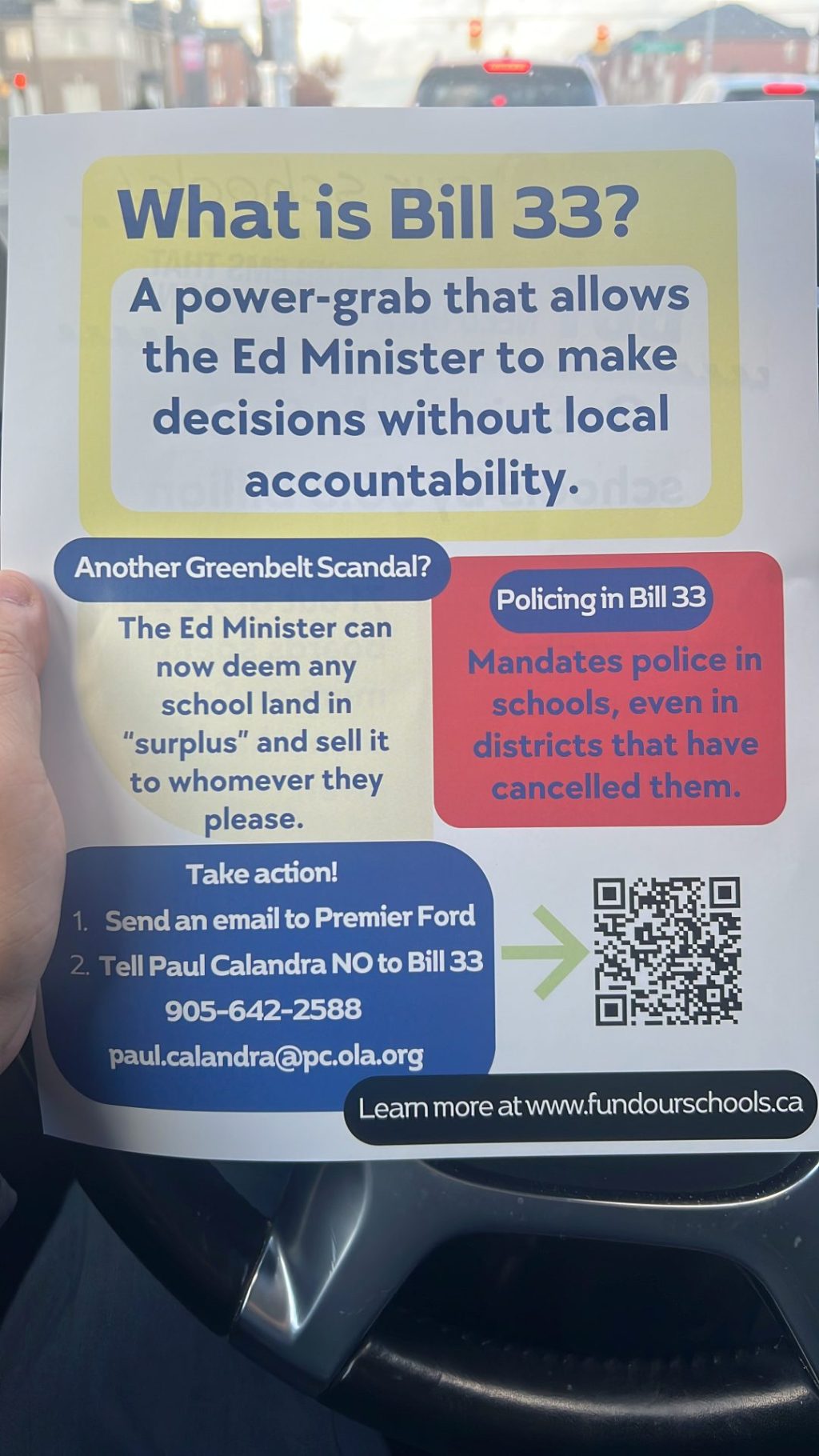
Yesterday, when I picked up my child from school, a teacher handed me a flyer about Bill 33, officially called the Supporting Children and Students Act (2025).
I tucked it into my bag, thinking it was another school notice about upcoming events. Later that evening, I finally read it — and I’m glad I did. What I thought would be a simple policy update turned out to be one of the most important education issues in Ontario right now.
The flyer was clear and passionate. It explained how Bill 33 could change how our schools are governed, how decisions are made, and even who has the final say in what happens inside our classrooms. As a parent and Catholic School Council member, I felt both curious and concerned.
So I decided to dig deeper — to understand what Bill 33 really is, what the government says it’s trying to achieve, and why so many teachers, parents, and education advocates across Ontario are speaking out.
What Is Bill 33?
Bill 33, the Supporting Children and Students Act (2025), is a proposed piece of provincial legislation that amends several key education and child-services laws, including:
- The Education Act
- The Child, Youth and Family Services Act (2017)
- The Ministry of Training, Colleges and Universities Act
- The Ombudsman Act
On the surface, it sounds administrative. But behind the legal language is a significant shift in how power and responsibility are distributed in Ontario’s education system.
In simple terms, Bill 33 would give the Minister of Education broad new powers to intervene in the operations of school boards. That means the province could make decisions that were once handled locally — by trustees, school boards, and communities.
What the Government Says the Bill Will Do
According to official statements, the Ontario government introduced Bill 33 to “strengthen accountability, transparency, and oversight” in education.
Key government claims include:
- Improving governance and financial responsibility at the school board level.
- Increasing public access to information — for example, requiring boards to post trustee and senior-staff expenses online.
- Mandating training for trustees and directors of education to improve leadership and compliance.
- Enhancing student safety and well-being by requiring collaboration with law enforcement and social service agencies.
Government officials insist that these reforms are about protecting students, ensuring taxpayer dollars are spent properly, and addressing problems before they escalate.
It sounds reasonable on paper — who doesn’t want accountability and transparency?
But when you read deeper, the details of Bill 33 raise more questions than answers.
Why Teachers and Education Advocates Are Concerned
Across Ontario, teachers’ federations, education workers, and parent groups have united in opposition to Bill 33. Their concern is not with accountability itself, but with how the bill achieves it — through centralized control rather than collaboration.
1. Loss of Local Decision-Making
One of the most worrying parts of Bill 33 is the new power it gives the Education Minister to take over a school board’s authority if the Minister believes the board is not acting in the “public interest.”
That phrase — public interest — is incredibly broad. It means the Minister could, at any time, override local decisions made by trustees who were elected to represent their communities.
In effect, it weakens the entire concept of local democracy in education. For Catholic boards, it could also limit the ability to make faith-based decisions that reflect the community’s values.
2. Power Over School Property and Land
Bill 33 would also allow the Minister to declare any school property “surplus” and decide what happens to it — including selling or repurposing it.
This could mean that valuable school lands — funded by taxpayers and meant for future educational use — could be sold to developers without community consultation.
Parents and teachers fear that this opens the door to another “Greenbelt-style” controversy where public assets could be privatized under the justification of “efficiency.”
3. Policing in Schools
Another contentious issue is the requirement for school boards to work with police services to deliver “safety programs.”
Many Ontario boards previously phased out School Resource Officer (SRO) programs after students — particularly racialized, Indigenous, and neurodiverse learners — reported feeling targeted and unsafe.
Reintroducing mandatory policing through legislation could undo years of progress toward creating inclusive, trauma-informed learning environments.
Teachers and parents alike have emphasized that real safety comes from trust, relationships, and mental-health supports — not surveillance.
4. More Bureaucracy, No New Funding
While the bill creates new reporting and compliance obligations for boards, it doesn’t include any additional funding for classrooms, staff, or special-education programs.
Teachers worry this will increase paperwork and administrative oversight — taking time and resources away from actual teaching and student learning.
For many educators already stretched thin, this could make things worse, not better.
5. Threat to Teacher Autonomy
When a central authority holds more power, teacher autonomy naturally shrinks.
Teachers are highly trained professionals who understand how to adapt lessons for different learning styles, manage classroom challenges, and support children with unique needs.
If boards must constantly follow ministerial directives, teachers may lose the flexibility they need to personalize learning.
That can be especially harmful for students who are gifted, have special needs, or require individualized approaches.
What This Means for Catholic Schools
As a Catholic parent, I view education not just as academics — but as a mission grounded in faith, compassion, and community service.
Catholic schools thrive on collaboration among parents, teachers, principals, and trustees. Every voice matters. Bill 33 risks disrupting that delicate balance.
Here’s how it could affect Catholic schools specifically:
- Local voice could be silenced. If the Minister can overrule trustees or boards, school councils may lose influence.
- Programs rooted in Catholic identity could face external control. Provincial mandates may not always align with Catholic values or priorities.
- Administrative workload could grow. Teachers and principals could spend more time on compliance, less on student engagement.
- Community partnerships could weaken. Decisions once made collaboratively might be dictated from Queen’s Park.
The strength of Catholic education lies in partnership — parents, teachers, and clergy working together to nurture children as whole persons.
Centralizing authority risks undermining that very foundation.
A Parent’s Perspective: Supporting Teachers and Protecting Local Voice
I’ve always believed that parents and teachers are partners in a child’s education. We both want our children to succeed academically, emotionally, and morally.
When teachers express concern about a piece of legislation, I pay attention — not because they’re being political, but because they see firsthand how policy affects real classrooms.
Teachers are not opposing accountability. They’re asking for policies that strengthen, not strain, the learning environment.
They want smaller class sizes, stable funding, better mental-health supports, and professional respect — not another layer of control from above.
When we talk about “supporting education,” it can’t just mean controlling budgets and boards. It has to mean supporting the people who make education happen: teachers, educational assistants, early-childhood educators, and principals.
As parents, we need to stand with them — not just in words, but in advocacy.
How Parents Can Take Action
Here’s how families across Ontario can make their voices heard:
- Read the actual bill.Visit ola.org
to see the full text. Understanding what’s in it is the first step to informed advocacy.
- Talk about it at School Council meetings.Ask how Bill 33 might impact your school’s governance, hot-lunch programs, fundraising, or classroom supports.
- Contact your local MPP.Politely share your concerns about centralized control and the need to protect local voices in education.
- Support your teachers publicly.When teachers speak out, share accurate information and thank them for standing up for students.
- Join advocacy campaigns.Websites such as fundourschools.ca
provide resources, petitions, and fact sheets for parents.
- Stay respectful and constructive.This is not about division — it’s about ensuring that our education system remains accountable to the people it serves.
Why This Moment Matters
Education shapes every part of our society — from our economy to our communities to our children’s future.
When government decisions start to move away from transparency and community voice, we all have a responsibility to pay attention.
Bill 33 may not dissolve Ontario’s school boards outright, but it weakens them in practice.
If passed, it would shift decision-making away from locally elected trustees, parents, and teachers — the very people who understand their students best.
As parents, we must remember: our voices matter.
Supporting teachers and defending local governance is not political — it’s about protecting the integrity of public education for the next generation.
In Summary
- Bill 33 gives the Minister of Education new powers to control and override school boards.
- It aims to increase “accountability,” but could reduce local democracy and teacher autonomy.
- It could reintroduce policing in schools, allow school land sales, and add bureaucracy without new funding.
- Catholic schools and local communities may lose flexibility to make faith-based or community-specific decisions.
- Parents can make a difference by staying informed, engaging respectfully, and supporting teachers who advocate for students.
 Yan Zhou on Catholic Education & Advocacy
Leave a comment